









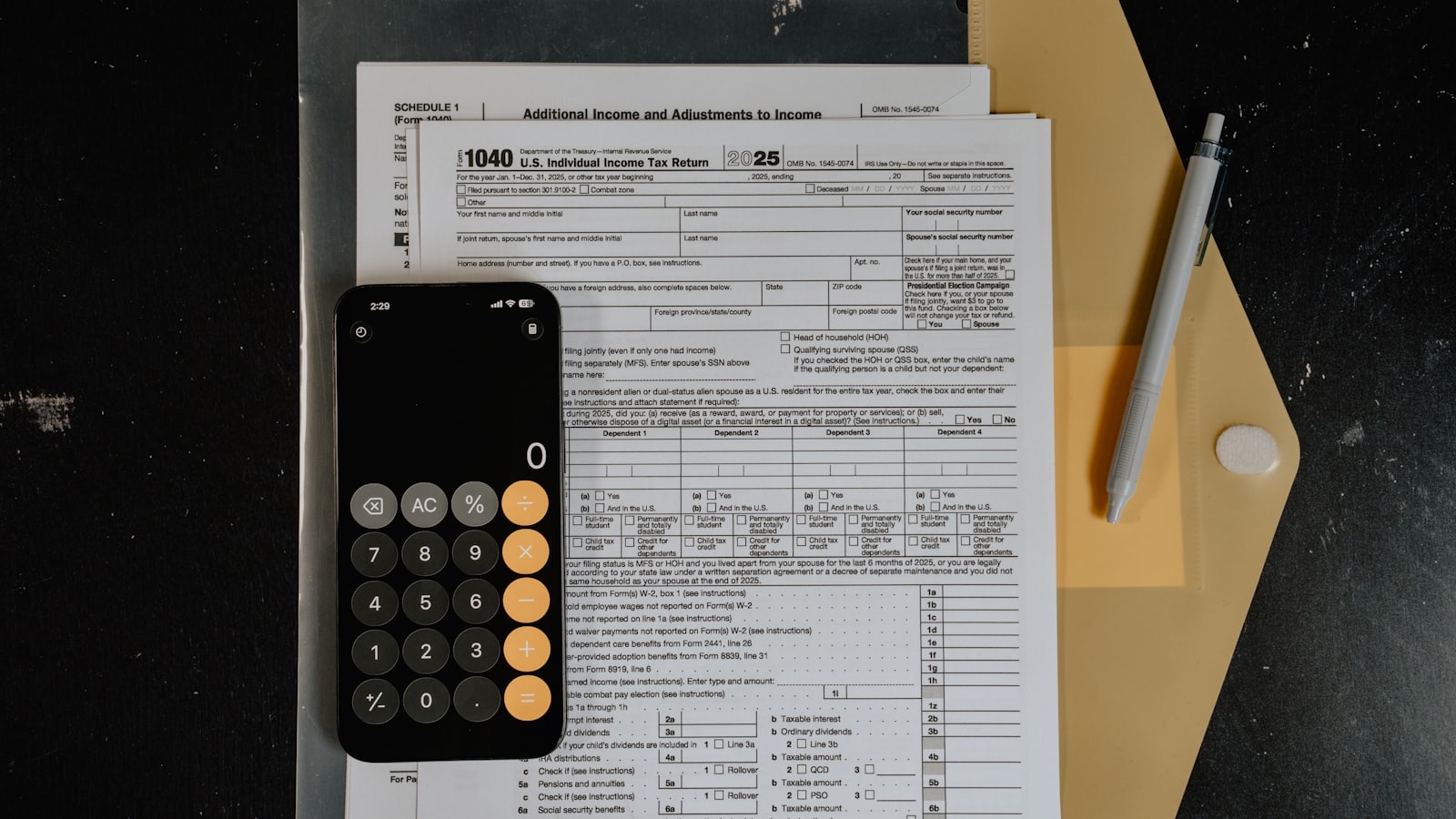





Federal tax brackets for 2026 were released by the IRS in late 2025 as part of the annual inflation adjustment. For Florida residents, who pay no state income tax, the federal tables are the complete picture. Every dollar of pass-through business income, W-2 wages, and taxable investment income is measured against the figures below.
The bracket shift is modest this year because inflation has cooled — but combined with the permanence of the 2017 Tax Cuts and Jobs Act rates under the One Big Beautiful Bill Act, rate planning in 2026 is more predictable than it has been in years. That predictability is what makes year-round planning tractable rather than guesswork.
37% is the top marginal federal rate for 2026 — unchanged and now permanent under the OBBBA (IRS Revenue Procedure 2025-32).
2026 Federal Brackets — Single Filers
For unmarried individuals and business owners filing single, the 2026 brackets apply after the standard or itemized deduction and any above-the-line adjustments are subtracted from adjusted gross income.
| Rate | Taxable Income |
|---|---|
| 10% | $0 – $12,400 |
| 12% | $12,401 – $50,400 |
| 22% | $50,401 – $107,350 |
| 24% | $107,351 – $204,900 |
| 32% | $204,901 – $260,200 |
| 35% | $260,201 – $650,600 |
| 37% | Over $650,600 |
2026 Federal Brackets — Married Filing Jointly
| Rate | Taxable Income |
|---|---|
| 10% | $0 – $24,800 |
| 12% | $24,801 – $100,800 |
| 22% | $100,801 – $214,700 |
| 24% | $214,701 – $409,800 |
| 32% | $409,801 – $520,400 |
| 35% | $520,401 – $780,800 |
| 37% | Over $780,800 |
A taxpayer in the 24% bracket does not pay 24% on every dollar. Lower rates apply to the income below each threshold; only income above the threshold is taxed at the higher rate. Bracket planning is the discipline of keeping income above a threshold as small as possible in any given year.
Standard Deduction & Key 2026 Limits
| Provision | 2025 | 2026 |
|---|---|---|
| Standard deduction, Single | $15,750 | $16,600 |
| Standard deduction, MFJ | $31,500 | $33,200 |
| 401(k) elective deferral | $23,500 | $24,500 |
| 401(k) catch-up (50+) | $7,500 | $8,000 |
| SEP / Solo 401(k) cap | $70,000 | $72,500 |
| HSA, family | $8,550 | $8,800 |
| Annual gift exclusion | $19,000 | $20,000 |
| Estate exemption (per person) | $13.99M | $14.4M |
What the Florida Owner Should Do
Florida's lack of a state income tax makes federal rate planning unusually high-leverage — every lever has to be federal. The moves that matter most:
- Review withholding against the new brackets to avoid the safe-harbor penalty or an interest-free loan to the IRS
- Recalculate Q1 2026 estimated payments using the new brackets and expected pass-through income
- Maximize retirement contributions at the new limits — stack salary deferrals with employer contributions via a Solo 401(k) or SEP
- Time income and deductions across year-end to land in the most favorable bracket
- Confirm the QBI deduction applies — the 2026 phase-in begins at $201,775 (single) / $403,550 (MFJ)
- Schedule a mid-year check-in in July, while there is still time to correct course
The Retirement Lever Is Bigger in 2026
The most reliable way to move down a bracket is to move pre-tax income into a retirement plan, and the 2026 limits give Florida owners more room than ever. A Solo 401(k) lets an owner-employee stack two contributions in one plan: the employee elective deferral plus an employer profit-sharing contribution, up to a combined cap. For a profitable single-owner S-corp or sole proprietorship, that can shelter tens of thousands of dollars — every one of which comes straight off taxable income and, near a threshold, can drop the marginal rate on the dollars just above it.
| 2026 retirement lever | Limit | Who it fits |
|---|---|---|
| 401(k) / Solo 401(k) elective deferral | $24,500 | Any owner with earned income |
| 401(k) catch-up (age 50+) | $8,000 additional | Owners 50 and older |
| SEP-IRA / Solo 401(k) total cap | $72,500 | High-profit sole props and S-corps |
| HSA, family coverage | $8,800 | Owners on a qualifying HDHP |
The sequencing matters as much as the amount. Elective deferrals must generally be elected before year-end, while employer profit-sharing and SEP contributions can be made up to the extended filing deadline — which means a Q4 projection can still be acted on well into the following year. Pairing a Solo 401(k) deferral with an HSA contribution attacks taxable income from two directions at once, and for an owner sitting just above a bracket line, that combination frequently does the work of a much larger single move.
Don't overlook the "backdoor" timing on employer contributions: because the profit-sharing side of a Solo 401(k) and the entire SEP contribution can be funded after year-end, you can wait until your books are final to size the exact contribution that lands you in the bracket you want. It's one of the few tax levers you can pull after the calendar year has already closed.
Filing With a Plan vs. Filing by Default
A return filed with a plan shows income smoothed across the year, deductions timed deliberately, and retirement contributions at the current-year maximum — and an April balance within $500 either direction, the mark of calibration. A return filed by default shows the residual: whatever happened to fall out of the calendar year, plus a large balance due or large refund, both signs of drift.
A Year-Round Bracket-Management Playbook
Because Florida owners carry only the federal load, the calendar — not a state form — is the entire game. Bracket management is a sequence of decisions spread across twelve months, not a scramble in December. Run it in order.
Project taxable income by March
Estimate the year's pass-through income, wages, and investment income against the 2026 tables so you know which threshold you're near before the money is committed.
Recalculate estimated payments each quarter
Update Form 1040-ES installments as the projection moves. Overpaying is an interest-free loan to the IRS; underpaying invites the safe-harbor penalty.
Run a mid-year check-in in July
Six months of actual data replaces the projection. July still leaves time to add a retirement plan, adjust an S-corp salary, or shift billing across year-end.
Execute year-end moves in Q4
Fund retirement to the new limits, time deductible expenses, and defer or accelerate income to land in the most favorable bracket before December 31.
A Florida S-corp owner with $260,000 of single-filer taxable income sits just $201 above the 32% threshold. A single additional $201 pre-tax retirement contribution drops the marginal bracket to 24%. The effect is hundreds of dollars on a small move — and thousands on a considered plan.
Ordinary Income vs. Long-Term Capital Gains
The 2026 brackets above govern ordinary income — wages, pass-through business profit, short-term gains, and most interest. Long-term capital gains and qualified dividends ride a separate, lower rate schedule (0%, 15%, or 20%), which is why the character of income matters as much as the amount. A Florida owner who can convert a slice of ordinary income into long-term gain often pays a materially lower federal rate on it.
Taxed at ordinary brackets (up to 37%)
- W-2 wages and reasonable S-corp compensation
- Pass-through business profit (Schedule K-1, Schedule C)
- Short-term capital gains (assets held ≤ 1 year)
- Most interest income and non-qualified dividends
- Guaranteed payments to a partner
Taxed at preferential rates (0% / 15% / 20%)
- Long-term capital gains (assets held > 1 year)
- Qualified dividends from most U.S. corporations
- Gain on qualified small-business stock, where eligible
- Installment-sale gain recognized over multiple years
- Long-term gain harvested inside the 0% bracket window
High earners should also watch the 3.8% Net Investment Income Tax, which applies to investment income once modified AGI exceeds $200,000 (single) / $250,000 (MFJ). It stacks on top of the capital-gains rate, so a "15% gain" can effectively cost 18.8%. Timing gains into a lower-income year — or offsetting them with harvested losses — is a core federal lever for Florida investors.
Plan your 2026 brackets before April decides for you
MK Tax & Accounting projects your income against the 2026 tables, calibrates your estimated payments, and times year-end moves so you land in the bracket you chose — not the one that happened.
Talk to a tax proSources
- IRS Revenue Procedure 2025-32 — 2026 Inflation Adjustments (IRS.gov)
- IRS — Section 199A Qualified Business Income Deduction (IRS.gov)
- IRS — Topic No. 409, Capital Gains and Losses (IRS.gov)
- IRS — Questions and Answers on the Net Investment Income Tax (Internal Revenue Code Section 1411)
- One Big Beautiful Bill Act — Permanent Extension of TCJA Individual Rates (Congress.gov)
Frequently asked questions
Yes. The One Big Beautiful Bill Act (July 2025) made the individual income-tax rates from the 2017 Tax Cuts and Jobs Act permanent. The scheduled 2026 sunset no longer applies — the 10/12/22/24/32/35/37% brackets continue, adjusted annually for inflation.
No. Florida imposes no personal income tax, so the federal brackets are the complete income-tax picture for Florida residents. That makes federal rate planning unusually high-leverage here.
Pass-through income from an S-corp flows to your individual return and is taxed at the individual brackets. Reasonable W-2 salary is also taxed at individual rates and subject to FICA. Planning the salary/distribution split is a core S-corp discipline.
For 2026 the standard deduction rises to $16,600 for single filers and $33,200 for married filing jointly, up from $15,750 and $31,500 in 2025 (IRS Revenue Procedure 2025-32). Because Florida has no state income tax, this larger federal deduction is the single biggest automatic shelter most Florida filers get, and it raises the income level at which each higher bracket starts to bite.


